

8 Longarm Quilting Myths - BUSTED!

Welcome!
I hope you had a wonderful Memorial Day weekend! Summer has unofficially reached Wisconsin. Beautiful, warm sunny days with occasional threats of popup thunderstorms due to the heat.
May has been a busy month and June promises an equally full calendar, so I thought I’d keep this post on the light side. As owners of The Quilting Connection, Rick and I regularly hear concerns about longarm quilting and the machines themselves that just aren’t true.
So, it’s time to bust the myths surrounding longarm quilting!
8 Longarm Quilting Myths – BUSTED!
Myth #1: Longarm quilting is cheating.
We hear this one all the time … especially when quilters are talking about using computerized systems like Handi Quilter’s Pro-Stitcher.
Let’s break it down by considering the types of quilting you can do with a longarm machine.

First, there are stationary longarm machines. When you use a stationary machine, you still move the fabric just like you would with your domestic machine. But these machines provide a much larger throat space (and a few additional features) that allow you plenty of room to work while quilting. No cheating there!

Then there are the moveable longarm machines … those that sit on a carriage. This allows the machine to glide both side to side and back and forth within the space created by your longarm frame.
You can use a moveable longarm to do free-motion, pantograph or computerized quilting.
When you free-motion quilt, you are basically drawing with thread. You do all the planning and designing. Then, once you’ve loaded your quilt top, back and batting, you control the movement of the machine head. It’s all you … you’re just moving the machine instead of the fabric. Cheating? No way!
With pantograph quilting, you are following a pre-printed paper pattern. You choose the design that fits your frame and is appropriate for your quilt. You load the pattern and adjust it for all four edges. Then, row by row, you guide the longarm for the entire quilt. Sound like cheating?
Finally, there’s computerized quilting. Yes, the computer is controlling the movement of the machine head in this instance, BUT there’s so much more involved!
Once you load your quilt top, back and batting, setup steps include choosing a design, sizing it to your quilt, placing the design and setting its density, and establishing the area being quilted. Then you’ll also have to advance the quilt when appropriate and resync the computer and the design. And once you reach the last row of your quilt, you may have more adjusting to do.
Plus, you must consider all the options and intricacies that are available with computerized longarm quilting. The learning curve to master even some of the possibilities can be steep, but also very rewarding!
So, is longarm quilting cheating? NO! It’s just using a different tool to complete your quilting … like using a domestic sewing machine instead of hand quilting. Additionally, each type of quilting requires a different skill set.
Myth #2: You need a huge quilting area to own a longarm.
While longarm systems can require a considerable amount of floor space, several options have been introduced to minimize this challenge.
Quilters who like free-motion quilting and moving the fabric versus the machine, can still enjoy the longarm experience by using a stationary machine.
For example, Handi Quilter offers the Moxie ST which has an 18” throat space and sits in a 38” square table. The Amara ST has a 20” throat space and also sits on a 38” square table. (In this case, table extensions are available to increase the surface area if you can accommodate it.)
With floor space in mind, longarm manufacturers have also developed moveable systems that have smaller footprints.

For example, Handi Quilter offers the Moxie with a 15” throat space that can sit on a 5’ Little Foot Frame. Factoring in the optimal floor space around the frame, you’re looking at a 6-8’ by 8-10’ area. It does require space, but a small, spare bedroom or a limited area in a basement can work.
Additional frame options are available depending on the longarm system you’re interested in. If space is one of your concerns, please call us at (262) 723-6775. We’ll help identify options that may work for you!
Myth #3: Quilting designs are boring and all look the same.
I think this myth comes from people who have only seen basic meanders and stipple designs on quilts.
Quilters who love free-motion quilting know that pretty much whatever they envision, they can quilt. Like I said before, it’s drawing with thread!
Paper pantograph quilters have hundreds of patterns available to them. Plus, you can purchase many of the designs in the size that works best for your quilts and longarm frame.
Computerized quilters have pretty much unlimited possibilities! For example, Pro-Stitcher Premium comes with over 800 designs. When you add the ability to purchase additional designs, resize designs, combine multiple designs and create your own designs, options are endless.
Whether you’re using paper pantographs or doing computerized quilting, design styles include modern, traditional, whimsical, elegant, simple and complex. With all these options available, there’s no way quilting designs can be considered boring!
Myth #4: Free-motion quilting is impossible to learn.
Free-motion quilting is magical! It takes designs from your brain and allows you to produce them on your quilt. AND it’s also doable by everyone!
Free-motion skills come with practice. Think of it like learning handwriting. You learn a certain number of shapes and then repeat and combine them to make different designs. Try loops, meanders and simple swirls to start. And focus on just one or two shapes at a time.

Start by doodling on paper or a whiteboard. Then move to practice sandwiches of fabric and batting. Action is the critical piece … it builds confidence!
And practicing frequently is key. That’s how you build muscle memory! Try to practice a little every day … just 15-20 minutes will do. You’ll build spatial awareness and fine motor control.
Will some free-motion quilters be more accomplished than others? Sure, but that doesn’t mean you can’t produce beautiful quilts!
Oh, and if you’d like a little personal guidance with your free-motion quilting, watch for our next series of in-person free-motion classes taught by award-winning quilter, Wendy Fuller. She’s an amazing teacher who can elevate your free-motion skills regardless of your current skill level!
Myth #5: Longarm quilting is only for professionals.
Many longarm quilters own their own machines, but they’re not all professionals. Some longarmers quilt just for themselves or for friends. They may produce donation quilts, gifts, or quilts to sell … in addition to quilts for themselves, of course!
Other longarm quilters do decide to turn their love of quilting into a business. And these businesses range anywhere from a small side business to quilters who own multiple, large longarm systems geared to completing multiple quilts per day.
If you’ve been wanting to try longarm quilting, The Quilting Connection has another option to offer. Consider renting time on one of our longarms! You start by taking a half-day class in which you learn some longarm quilting basics, and then you’re ready to rent.
For more information, see the Beginning Rental Longarm Classes
listed on Classes page of our website.
But remember, you can own a longarm system simply for the fun and enjoyment of doing your own quilts!
Myth #6: You can’t quilt small projects on a longarm.
Oh my gosh, longarms can make quilting your small projects so much easier!
You can load one large piece of backing fabric and baste on multiple table toppers, placemats, table runners, mug rugs, etc. Then you can use whatever style of quilting you prefer to complete them all at once.

And longarm machines can easily handle individual wall-hangings, baby quilts and other small projects.
Myth #7: Longarm quilting is faster but lower quality.
First, longarm quilting MAY be faster. When it comes to speed, there are several factors to consider including type of quilting, size and style of the quilt design, and density of the design.
If you choose to do free-motion quilting, you can spend hours on a quilt depending on the intricacy and size of your designs.
Even computerized quilting can take a considerable amount of time. If you choose a small, dense design or one with a lot of back-tracking in the stitching, it will take a while to complete your quilt. And if you’re custom quilting each block, especially with small, dense fill designs, that will take even longer.
As far as lower quality, no way! Features such as stitch regulation and the precision of computerized quilting can increase the quality of quilts completed on longarm machines.
Myth #8: Once you buy a longarm, quilting is easy and the machine does all the work.
Uh, no! First off, you buy a longarm with the features you need to complete the style of quilting you want to do … free-motion, pantograph and/or computerized. Each of those quilting styles has a learning curve, both from a machine and an operator perspective.
Then you will always have decisions to make as the quilter … what batting, thread and needle to use; the best or most efficient way to load your quilt; design, density and placement decisions; etc.
And the machine definitely doesn’t do all the work. You still need to make sure you’re starting with a machine-friendly top and back which then you have to load onto the frame.
Then you need to do any pattern or computer setup. Tension must be checked, and you have to deal with any thread breaks, empty bobbins, fabric or stitch issues, or any other glitches that arise. (You definitely can’t just start the machine and walk away. Supervision is required!) Plus, you’re still advancing the quilt as each row or area is complete and keeping the design aligned.
And reaching the bottom of your quilt doesn’t necessarily mean you’re done. You may roll back your quilt so you can complete additional quilting or add your binding. Finally, you get to unload your quilt which then may need the binding to be finished and/or a label to be added.
You’re still very involved when quilting on a longarm machine. It’s not about easy or letting the machine do all the work. Longarm quilting is about enjoying what you’re doing and feeling satisfied with what you create!
Eight longarm quilting myths busted! Any new realizations or thoughts based on what I shared? Do you have any other myths that need to be debunked? Or do you know someone who would benefit from reading this post? Is so, please forward and share!
Distributor Sales
Handi Quilter
Here’s what Handi Quilter is offering through June 26th!
If you’re interested in a Moxie longarm or the Pro-Stitcher Lite …

And if you’re interested in an Amara, Infinity or Premium Pro-Stitcher …

Additional savings may be available … contact us at 262-723-6775 for more information!
Quilting Central Podcast Update
Check Out the Latest QCP Episode
Adam Sew Fun Reveals His Quilting Journey
In this episode Julie, Cathy and I have the pleasure of sitting down with Adam Sew Fun and having a laugh-filled conversation about his quilting journey.
Adam shares how he got his first longarm and the important steps he took from starting as a beginner quilting enthusiast to becoming a recognized quilting personality. Plus, you’ll hear about what he’s working toward next!
Expect plenty of laughs, honest stories, quilting tips and inspiration for quilters of all skill levels!
And remember, for a complete listing of all our episodes, visit the Quilting Central Podcast YouTube channel! Please subscribe and comment. We ‘d love to hear your thoughts!
But wait, one more Quilting Central Podcast update!
We’ve scheduled another virtual retreat! Join us for the …
Holiday Stitchcation Virtual Retreat
From Cutting to Binding – Let’s Make a Quilt Together!
July 26-28, 2026
Sunday – 1:30 to 6:00 PM
Monday & Tuesday – 5:30 to 8:00 PM
Live Stream Video on Streamyard
For more details on the retreat and the Christmas project that we’ll be making together,
click on the above link!
Have you seen the latest Patreon video?
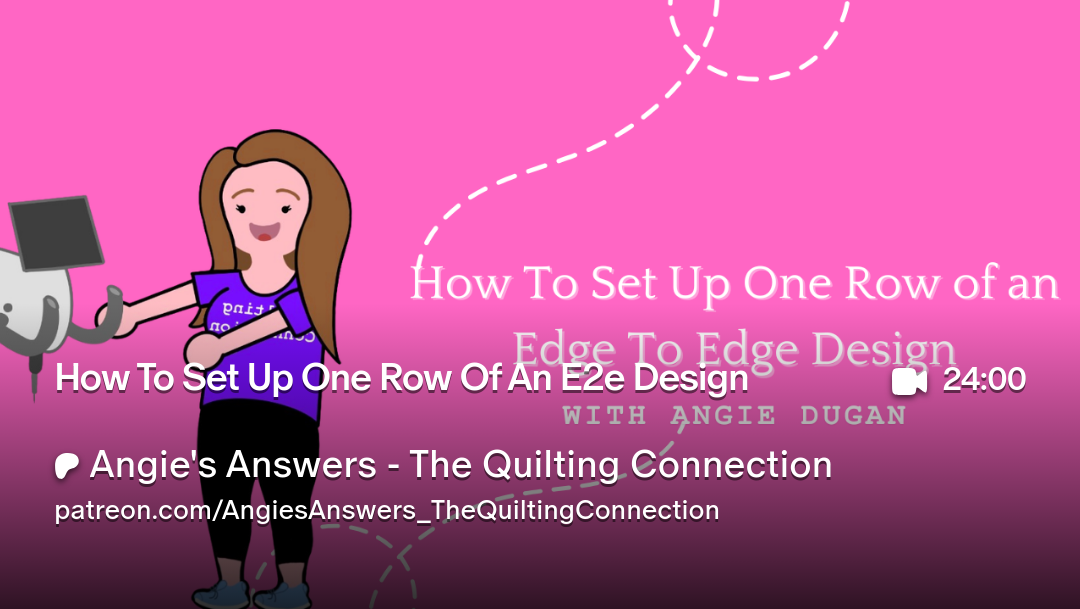
What is Patreon? Patreon is a membership-based platform that allows content creators to offer behind-the-scenes content, early access to videos, or bonus episodes to supporters. You can access Patreon on any device, through their website or app.
Okay, that’s a wrap!
Please remember, if you ever have ANY questions or want additional information about ANY of the products and services The Quilting Connection offers, please call us at (262) 723-6775 or email us at info@QuiltingConnection.com.
You can also visit us online at QuiltingConnection.com or in person at 21 Adams Street in Elkhorn, WI (usually M-F 9-4, please call to confirm we’re open) or 1017 W. Northland in Appleton, WI (W, Th & F 10-4, S 10-3).
Finally, check out our blog at QuiltingConnection.com/blog and our Facebook posts.
And please share your thoughts and questions. I’d love to hear from you!